Beguines of Provence

Douceline de DIGNE(+/-1214/15 – 1274)

Native of Digne (South of France), she was born in a pious bourgeois family, then grew up in Barjois. She makes the decision to become a beguine by returning from a stay at the convent of thr Poor Clares of Digne. (Source: Wikipedia).
In the 1240s, Douceline de Digne, sister of the Franciscan Hugues de Digne, founded two beguinages in Provence that espoused charitable works, collectively known as the House of Roubaud. Douceline believed that the role of founder and spiritual mother of lay religious women included a commitment to the ideals of active charity and absolute poverty. The thesis  of Kelly Lynn Morris addresses two inter-related issues. Firstly, from Douceline’s vita, we can argue that her expressions of evangelical charity and absolute poverty were an orthodox reflection of a composite of Franciscan, beguinal, and mystic spiritual ideals. The second issue challenges Aviad Kleinberg’s evaluation of Douceline as a conscious agent in the creation and manipulation of her own sanctity by demonstrating that the development of Douceline’s orthodox sanctity was based upon a co-operative commitment by the community to create a lifestyle that embodied active charity.
Sources:
www.medievalist.net , www.wikipedia.com
The vita of Douceline de Digne (1214-1274): Beguine spirituality and orthodoxy in thirteenth century Marseilles  by Kelly Lynn Morris

More Information I got while I was translating into Italian the book of J.H. Albanès*
Icon of Saint Douceline
by Elisabeth Lamour

Nomen est omen” (the name is a sign), as the Latins say, meaning the omen of the name on the person’s life. This was certainly the case for Douceline. “A note of quiet and transparent sweetness runs through the entire length of her story and permeates her prayer, the soliloquies of her soul, her visions, the mystical escapes of her spirit, the aerial lightness of her body in the transports of levitation.” (p. 6), we read in the preface by Claude-Louis Combet, who speaks of the “mellifluence” of her name.
Gentleness and patience, no doubt, but also firmness and determination in the creation of the beguinal project, that she received directly from the Virgin Mary. It quickly attracted a large number of people, especially widows, from the families of the Provençal bourgeoisie and aristocracy.
She founded two beguines’ houses, which she named Maison Roubaud, after the local river, and which she administered with fervor and authority. Demanding of herself, she held dear the values ​​of humility, simplicity, and compassion for the sick, in the footsteps of her own father, her brother Hugues de Digne, and the Poor Francis of Assisi. The latter two would be her role models throughout her mission.
Hugues de Digne, a renowned Franciscan close to the thought of Joachim of Flore, found his feminine double in his younger sister, as Francis of Assisi did with Claire. However, Douceline displayed a distrust of other men, showing herself uncompromising towards those of her sisters who deviated from this rule.
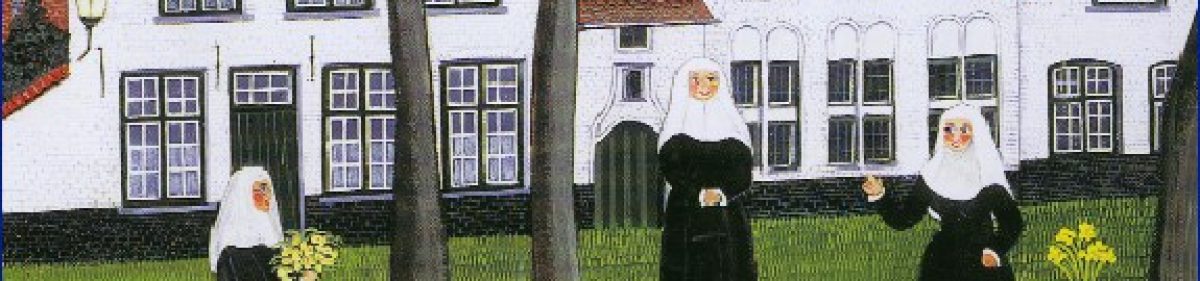
Douceline was not a nun, even though she had chosen to take a vow with her brother “of virginity, poverty, and obedience,” but “she never belonged to any order and always lived in the world.” (p. 81) The beguines of the Roubaud community were able to retain their property and thus support the beguinage. Enclosure was not in the Rule, so it follows that “they could leave the establishment and even live outside it.” (p. 83) They were city dwellers, integrated into the society of the time. Their dress was secular, modest, dark in color with a linen or white cloth mantilla, the “béguin” (beguin) which remained in the French vernacular.
More adept at ecstasy than writing, Douceline had an intense relationship with trees, birds, and flowers since childhood.
A miracle-worker, she experienced healings that also made her famous among influential people, notably the counts of Provence. Prone to ecstasies and levitation, she was sometimes the object of unhealthy curiosities and refused to make them public.
She died in the Marseille beguinage in the suburb that later took the name Roubaud, surrounded by her community of beguines, Franciscan friars, and the Sisters of Sion. Crowds of Marseille residents flocked to her, already recognizing her in the odor of sanctity.

This text was revised by Vivianne-Marie and Muriel Raphaëlle (Mémoire d’Elles). Thanks to them.

* J.H. Albanès (curator and translator into French), La Vie de Sainte Douceline, composed in the thirteenth century in Provençal by Philippine de Porcellet, Preface Claude-Louis Combet, Éd, Jerôme Millon, 2020

Philippine of PORCELLET (13th)

Originally from Arles, she is a disciple of Douceline de Digne and takes part of the community that settled around her, outside the city of Hyères, where ladies of Provence, eager to devote themselves to God, live without imposing a canonical rule. They are dedicated to the poor and the sick. In 1297, Philippine writes in Occitan La Vida Beneaurada Sancta Douceline, which was translated into French by Abbot J.H. Albanès in 1879. Philippine’s work is the only text that tells us about Douceline, her personality, her inner life, her spiritual adventure. It is currently in Paris at the Bibliothèque Nationale.
Experts believe that this hagiography was written “shortly after the death of the Saint” (p. 37) and that it was written in Occitan to make it understandable to the disciples in order to revive in them the memory of the holy mother, her virtues, her words, her miracles. Nevertheless, the beguines used vernacular languages throughout their texts.
Philippine, Lady of Artignosc, descended from one of the most solid genealogies of Provence. She was married to Fouques de Pontèves, was the mother of three daughters, but was quickly widowed and immediately afterward joined the Roubaud household. Because she was powerful and wealthy, she provided for the needs of the Institute. She outlived Saint Douceline by more than forty years. After the Saint’s death, she was chosen by the Beguines to head the establishment, just as she had already been the Vicar who had been dismissed by Douceline herself during her lifetime.

Here are the names of the Beguine Prioresses of Roubaud, as compiled by Abbot Albanès:

I. Saint Douceline, 1250?-1274
II. Philippine de Porcellet, 1274?
III. Huguette Ancelme, April 20, 1292.
IV. Bérengère de Flotte, January 13, 1298.
V. Philippine de Porcellet, the Younger, 1329-1341.
VI. Jeanne de Porcellet, July 17, 1343
VII. Douce de Vivaud, 1359-1366.
VIII. Jacquette Monnier, June 7, 1390.
IX. Marguerite de Ulmo, 1397-1401.
X. Marguerite d’Alon, 1397-1414.
We believe that these last two names designate one and the same person, who was prioress of the beguinage at least since 1395. (p.94.95)

RIXENDA (13th)
This beguine of Narbonne in southern France testified that around 1280 she has carried off to heaven and saw Jesus standing and his mother Mary rigth next to him and nearby Saint Francis…she saw her father and mother in Purgatory…and they say that tank to her prayers many souls are taken from Purgatory…she saw her father and mother at the Gate of Heaven, and shortly thereafter they were received into their mansion” (Laura Swam, The winsdom of beguines, p.114)

SPARRONE (13th)
Beguine of Aix-en-Provence, she is mentioned in the list of  “Beghine, Begardi, Beghinaggi”, edited by A. Mens in the Italian Dictionnary of Institutes of Perfection, pp. 1166-1180. Also Sparrone was part of the community of the Dames of Roubaud grown around Douceline de Digne.

Sources:
Wikipedia
J.H. Albanès (curator and translator into French), La Vie de Sainte Douceline, composed in the thirteenth century in Provençal by Philippine de Porcellet, Preface Claude-Louis Combet, Éd, Jerôme Millon, 2020


En continuant à utiliser le site, vous acceptez l’utilisation des cookies. Questo sito utilizza due cookies tecnici. Se siete d'accordo potete continuare. his site uses two technical cookies. If you agree you can continue. Plus d’informations

Questo sito utilizza due cookies tecnici. Se siete d'accordo potete continuare. Ce site utilise deux cookies techniques. Si vous êtes d'accord, vous pouvez continuer. This site uses two technical cookies. If you agree you can continue.

Fermer