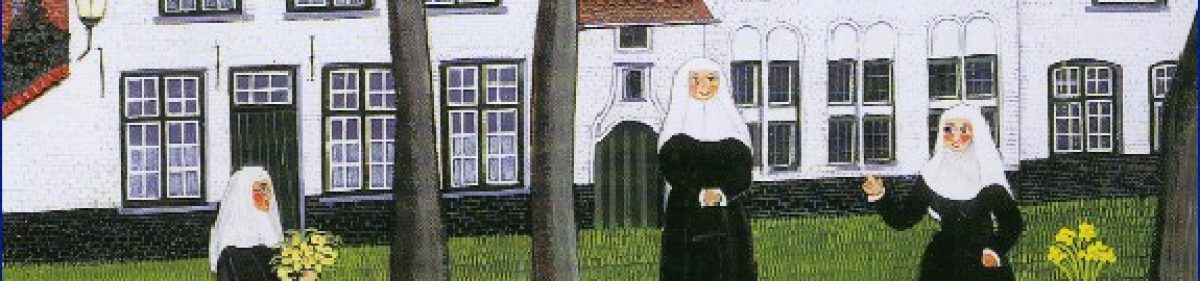
 Gertrud Maria Hofmann-Startz, was born on December 3, 1925, in Mödrath Castle, a maternity ward run by the Cellite Sisters (formerly Beguines). She came from a wealthy family and had a happy childhood with her brother and three sisters.
She passed her Abitur (university entrance exam) three times during the war, most recently in Bonn-Pützchen. Even then, she was already writing plays, which were performed with great success.
As early as 1947, she was teaching at the Hildegardis School in Cologne, where she always found particular joy in her teaching.
In Bonn, she studied Catholic Theology with another student: the usual form of address was “Gentlemen,” and the “Ladies” were overlooked!
In Munich, where Professor Sedlmaier brought her, she was a fellow student of Ratzinger, the future Pope Benedict XVI. As early as 1950, after her exams, she wanted to write a doctoral dissertation on “The Diaconate of Women in the Catholic Church.” However, since her family sent her to America and her doctoral advisor died, she stayed there for about three years, studying American language, history, and psychology, while also working as a nurse. For a long time, she traveled with Native Americans. It was there that she learned to see and understand the world through God’s eyes.
Back in Europe, Gertrud became the first and enthusiastic teacher to accompany the student exchange program with Spain. Together with Father Schlachter, the youth chaplain in Frankfurt, she contributed to the first religious education textbook for vocational schools, which is still in use today.
In 1956, her mother was in a very serious car accident. Since Gertrud was the only unmarried daughter, she cared for her mother and accompanied her to a health resort in the Black Forest. She also studied medicine in Freiburg. After her mother’s recovery, she continued her medical studies in Graz, where she met her future husband, who initially worked as a lecturer in the cardiac surgery department and later as a urologist. They married in 1958 and had two sons and two daughters.
A saying of her husband’s became her guiding principle: “Live in God and always rejoice!” Another guiding principle she adopted from her grandmother: “You only keep what you give away!” And also a motto of the medieval Beguines: “In worship, especially in communion, God serves us; in charity, we serve God.”
Due to tragic circumstances, Gertrude lost her fortune. The family lived as refugees, and when her husband died young, she had to raise the children alone with little money and felt very isolated. This was a formative experience of loss and existential hardship for her, one that would have lasting consequences.
As a result, when the children grew up, Gertrude spent almost every night keeping vigil somewhere. Until her illness, she slept at home rarely, guided by the motto, “Caring for another person is an enrichment that cannot be replaced by anything else.”
Training as a hospital chaplain allowed her to work in this field for many years, and she also kept vigil at churches with other Beguines. She says, “I have always done what I was asked to do, what circumstances or people needed,” or rather, “what God placed at my feet.”
The experiences she gained and her research were incorporated into her 1990 book The Good Samaritans. That book went was republished as Transforming Time into Love.
But let’s rewind a bit: as a single woman of about 60, she searched for a long time for a religious community. However, she was rejected everywhere because of her age. Only the Benedictine nuns of the parish mission at the Beguinage in Bruges accepted her. Upon taking her vows, she received the mission to follow her heart and revive the Beguine movement in Germany. Gertrud Hofmann recognized how significant the Beguines would be for our time, that women, as almost 800 years ago, were once again able to live by the work of their own hands, to stand together independently and voluntarily, and to assume responsibility far beyond themselves, and how desperately our time needed the competence and commitment of women.
She conducted her own research and succeeded in getting the word “Beguine” reintroduced into archives and libraries. She wrote her book and gave lectures everywhere. This led to numerous diploma and doctoral theses, which she helped supervise.
After founding a Beguinage in Essen herself to shelter the homeless, her initiative led to the establishment of 20 Beguine communities across Germany, housing over 600 women and children. She later became an honorary resident of *Beguines Today e.V.* at the Bochum Beguinage and co-founded the *Notburga-Gemeinschaft* community in Austria in 1987.
In 2004, the umbrella organization for Beguines (www.dachverband-der-beginen.de) was founded; it promotes the Beguine ideal, offers advice and support to new Beguines and communities, handles numerous inquiries, and holds lectures upon request. Its program includes annual study trips for Beguines as well as a national Beguine gathering held every year in late August.
Gertrud celebrated her 100th birthday with her family on December 3d, 2025. And on the Christmas’day , she was able to return her life into the hands of her Creator. God surely welcomed her with open arms, for she had done so much good for so many people during her life as a Beguine.
All information was provided by Brita Lieb, drawing primarily from the commemorative text she wrote and read at the unveiling of the memorial stele dedicated to Gertrud in the Women’s Memorial Labyrinth in May 2006.
You must be logged in to post a comment.